
“Today, Mies van der Rohe would probably be an Instagram star,” says architect Bernadette Krejs, who will be the next guest of this year’s November Talks
13/11/2025

Vienna is often brought up as an example of functional social housing. What is its strength?
I’m frequently asked that by people when they come to Vienna. A lot of people come here to see how the "Viennese housing model" works. And they ask: How does it work? Can it be copied?
Approximately more than 50% of the apartments In Vienna fall into the category of subsidized, social or municipal housing. And what is extraordinary compared to other European cities, is that the city has never sold this housing stock.
Vienna has a very long history of being governed predominantly by social democrats. The idea of the city as a caregiver—a city that functions as a welfare state and provides housing for its residents—was popularized during the so-called Red Vienna period. This was when the famous “workers’ palaces” such as the Karl-Marx-Hof began to be built.
If you want an apartment in Vienna, you will find one. It may take a while and you need certain skills, like language, to navigate the complicated system. But the main thing is that it is a program for the middle-class – there is no stigma attached to living in a social housing. It does not mean that you “didn’t make it in life”. On the contrary, you can get into the social housing system even with a relatively high income.
So yes, it is a great model, but of course, even Vienna has its problems. A city needs to remain innovative, respond to the current crises and find new ways to improve this model.
How is social housing changing in today’s Vienna – is the city facing the same kinds of pressures as other European cities?
Yes, absolutely. We live in a capitalist economy and the pressure on the housing market is felt in almost all cities. There is a free market where apartments are seen as goods, as investments – it is the commodification of housing. Housing is no longer seen as a human right, but as something that has value and can be traded.
Additionally, I would say we are all facing not just a climate crisis, but a real, impending climate catastrophe – bringing social segregation, high temperatures, overheating and so on. In Vienna, temperatures have been rising noticeably in recent years.
At the same time, I’m seeing that instead of strengthening the welfare state, society is moving towards individualization – where everyone must take care of themselves.
And even in a city like Vienna, there are groups that are left behind in terms of access to social housing or even to the free market. From a feminist and intersectional perspective, these are often women or those who come from other countries, have different cultural backgrounds or lack the necessary documents. We often don’t think about these groups when designing and planning or creating social housing policies.
This is the reality of the world today. Some cities are responding better to it, some worse, but it is very challenging for all of them. We all have the same problems – it’s only about how we respond to them, right?
Your view is that the pandemic changed the way people think about their housing and the neighborhood they live in. In what ways specifically?
I think the pandemic put the issue of housing in the spotlight. Suddenly, it mattered how much space we have, whether we can work from home, teach our children and live our daily lives. It turned out that we don't all have the same conditions – some have better facilities, others live with a big family in a 50-meter apartment and try to juggle employment and housework at the same time. The pandemic highlighted the inequalities and pressures faced by people in different types of households, and has shown that the quality of the home is a deeply social issue.

You work at the Housing and Design Research Department at the Technical University of Vienna. Would it be accurate to say that this department functions as a laboratory for finding new forms of housing?
Yes, we are a relatively large department of 15 people. The classic university structure, with its division into departments of housing, urban planning, typology and so on, is actually a very old model that has never been fundamentally challenged. At the same time, housing cannot be perceived as a closed “box”, separated from the rest. At our department we view housing in a broader sense, as the milieu of people, animals, nature, the elderly and non-binary people. We are interested in spatial justice, which ties into climate and social justice.
We have different approaches. Some colleagues are dedicated to design-build projects, while others explore ways of adapting post-war housing stock. I focus on feminist and intersectional planning – how to engage different groups in housing and the design process. And because housing is a deeply interdisciplinary topic, we collaborate with experts in the fields of law, economics and sociology, as well as with the city of Vienna and researchers from other countries. Contact with other colleagues, such as from Brazil for example, helps us to see that elsewhere, there are other strategies that work – for example, strong civic engagement in housing, which is not common in Vienna. This too inspires us to seek new paths.
What direction do you guide your students in when they are thinking about housing?
One studio, which I head together with Max Utech, is called the “Palace of Un/Learning”. With the students, we explored what we need to “unlearn” in order to do design, plan and build with less harm and extraction. We connected the topic of housing, home and occupancy with the question of how we learn at university – what role models we have, who we quote and who we overlook in the architectural canon.
We involved students in the decision-making and learning process from the beginning. We functioned more as hosts than teachers, creating a space for knowledge sharing. Because to certain extend we are all “housing experts” because we are all living in some way. We were interested in what we could learn collectively – and it was often the students who brought new insights, like when they explored the material footprint of our own studio.
Next semester we will work on the topic of queering the home—that will ask ourselves how to think about the home differently, in terms of financing and forms of coexistence, friendship, and family.
Last year, as part of your studio teaching, you explored the home through artificial intelligence. What new images of housing emerged during this experiment – did they surprise you in any way?
We architects are image creators – it’s our language, which we use talk about space – and these images have enormous power to shape how we think about and evaluate architecture. Many new AI tools have emerged in recent years and it’s been fascinating to experiment with them. I think it’s important to understand technology, not just use it – to examine where it comes from, who creates it, what archives and datasets it uses, and what biases are embedded in it.
We tried to “hack” artificial intelligence – to use it in a way that was not originally intended. We wondered if it was even possible to create an image that is not reproducing the aesthetics of real estate ads and social media accounts. It was difficult to achieve original and surprising outputs, but the students worked very critically with it, combining it with physical and manual techniques. It was important for us to understand that AI is not just a “new pencil”, but a tool connected to the economy, the market and the environmental footprint.
Nevertheless, students created surprising images of housing. The students were pointing out that the images that surround us often completely ignore the reality of care, work and inequalities. The aim was to search for new images of the future that would show that the home is not just an investment product, but a place of daily work, relationships and sharing.

You are the co-founder of Claiming*Spaces, a collective that addresses queer-feminist issues in architecture. What led you to found such a group?
We founded the collective in 2019. It is a diverse group of students, researchers, and educators at the Vienna University of Technology. We felt that something was missing at the school: topics such as climate change, gender diversity, inclusion, and accessibility were missing in the curriculum. So, we started creating the missing courses ourselves, organizing conferences, and collaborating with students and feminist collectives from around the world.
Today, we are part of the Parity Front, an international network connecting groups from architectural institutions in Europe and the US and striving for greater diversity and equality in education. Together, we look for ways to change the curriculum, what content to add, and how to support women and other disadvantaged groups in academia. We constantly learn from others and from each other. Our goal is to make the university more open, inclusive, and responsive to topics that have been lacking up to now.
That may also be one of the reasons you received the 2023 Best Teaching Award for gender-sensitive teaching at your university. How, specifically, is this approach manifested in your teaching?
This award is given once a year. But it is regularly won by men. This began attracting criticism, so eventually a special category called “gender-sensitive teaching” was created, which I found a bit sad. I wish gender issues were reflected in all forms of teaching, not just in one category.
Max Utech and I won the award for the studio I was talking about – “Palace of Un/learning”, where we tried to be very open and sensitive about who was visible, who was part of the seminar and how to create an atmosphere where everyone felt secure. The students’ reactions were very positive – they enjoyed the (un)learning and so did we. We were truly grateful that the university appreciated the potential of teaching that was inclusive and open.
Do you think that architectural education in general has a problem with gender inequality?
That is a tough question. The rights LGBTQIA+ people today cannot be taken for granted and can disappear very quickly. That’s why we founded our collective Claiming*Spaces and why we’re connecting with other groups. This shouldn’t be seen as a feminist struggle – it benefits everyone, regardless of identity. The world can be a much bigger and richer place if we give space to more voices.
When I was a student, we never heard anything about African architecture, for example – and now that almost feels like a betrayal. Opening to new perspectives, whether it's about gender, culture, race or class, is an opportunity that I think we can all benefit from.
You spoke of your project Palace of Un/Learning, which encourages “unlearning” established professional practices in architecture. What should we as architects and society unlearn?
The process of “unlearning” is is not about forgetting or canceling existing knowledge it is about choosing another model and transforming, adding and build up other forms of knowledges. The construction industry produces over 40% of CO₂ emissions and architecture is to some extent an “accomplice” in this. If we want a healthy planet, we must unlearn some of the ingrained processes.. Resources are not infinite, and we must change the way we plan, build and teach architecture.
That doesn’t mean halting construction but rather rethinking how we do things – from education to working conditions to the question of who has access to housing. “Unlearning” is a chance to rethink what we take for granted – whether we still need to design for the nuclear family model, for example, or whether other forms of coexistence can work.
As part of this project, you decided, among other things, to question the Barcelona Pavilion – what led you to this particular icon of modernism?
When I was studying, the Barcelona Pavilion and even the biography of Mies van der Rohe were completely untouchable. His buildings came up in every lecture. I don’t want to question in any way the quality of the Barcelona Pavilion, from an architectural point of view it is a truly beautiful work. But its official story is very linear and one-dimensional. Many people who were involved in the design process have been erased for a very long time from the Pavilions narrative. Lili Reich’s involvement and contribution in the project has only recently been rediscovered.
It is also interesting that not many people saw the original pavilion with their own eyes – it only stood for a few weeks at the World Expo and then was demolished. Its fame was mainly later ensured by photographs. It was thanks to these photos that it became an icon. Mies van der Rohe was a genius at media presentation – today he would probably be an Instagram star (laughs). In the 1950s there was a wide publishing of the pavilion, for example the exhibition at MoMA – this is one of the reasons why the building became so famous. With our intervention at the Pavillion we wanted to disrupt this very linear success story: To see if there were other, neglected stories, other characters, other ways of being present in that space.
You placed a large pink fur coat in the middle of the pavilion. What did that symbolize?
We noticed that any trace of domesticity has been completely erased from the pavilion. It is purely a building for representation, for example there are no stairs to the basement on the plans, because it is not a representative element.
This is why we introduced symbols of “domesticity” into it – curtains, colorful, soft fabrics or the fake pink fur you asked about. In short, materials that modernism excluded as too soft, feminine or exotic. We wanted to find out how the building reacts to these materials. We also collaborated with performers from queer and ballroom cultures. During the installation and the performances people really stayed at the pavilion, lay down, rested – the space became open to other ways of being. It was a wonderful two days when we could experience the pavilion in a completely different way – and the Mies van der Rohe Foundation also supported us wonderfully in this.
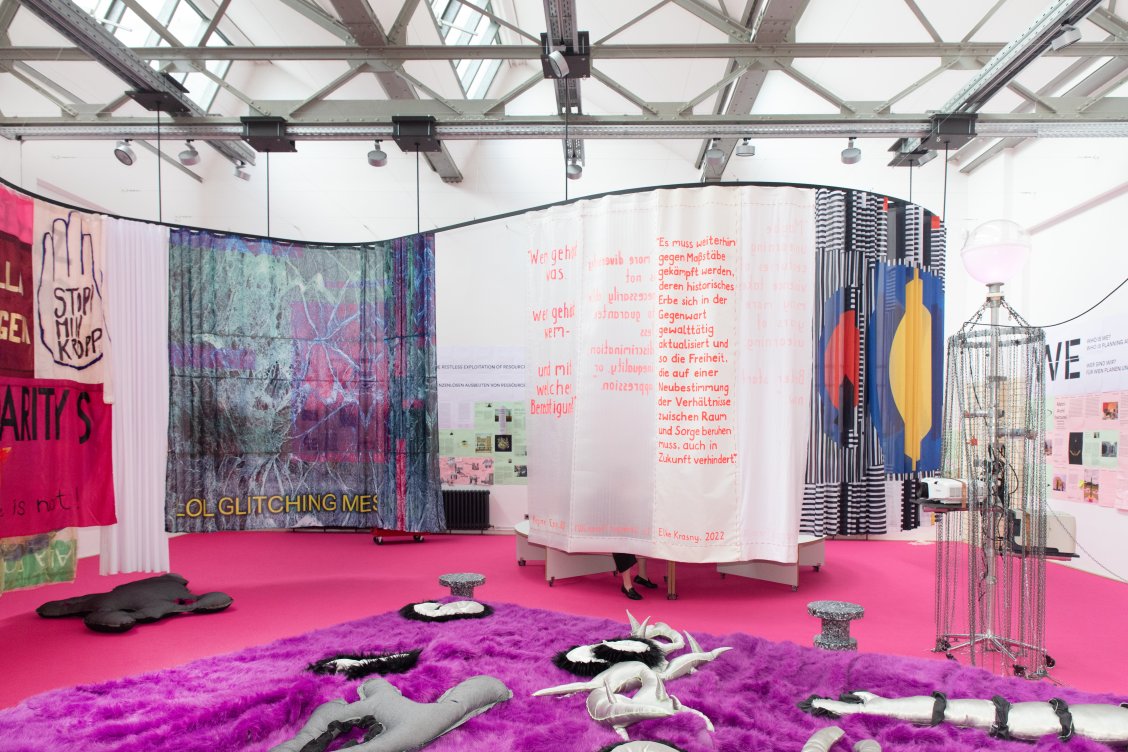
Your dissertation, titled Instagram Wohnen, addresses the impact of the media presentation of aestheticized worlds of housing on platforms like Instagram on the understanding of architecture, space, and housing. Why did you decide to pursue this line of research?
The research stems from my long-standing interest in other forms of representation. I began to examine what normative and standardized images of the home surround us. Social media today fundamentally influences our perception of the world – we spend a lot of time on it and in a way, these networks create a kind of seductive, engaging reality.
I was interested in how these popular “home accounts” influence our ideas about home – what it should look like, how we should behave in it, but also how we as architects design these spaces. What part do the technology and economics of platforms like Instagram or Airbnb play in this? Do these platforms show the care work and conflicts that really take place in the domestic space? And is it possible for such images to even garner visibility in the platform environment? These media appear to be public, but in reality, they belong to monopoly companies – we are “residents” in them without the possibility of choice, we follow rules that we don’t even know all that well. My book therefore examines how these platforms work, what images the algorithm prioritizes, and which ones disappear, who is behind them, and what power and gender structures they reproduce.
I think it's important for architects to engage more with media, not just as users of it, but as someone who understands its influence and can transform it – to become an active participant, not just a consumer.
Do you have any specific examples of how social media shapes our homes?
Yes, in the book I mention several influences that these digital visual aestheticized images from popular ‘home accounts’ have on how we live. One of the most striking is that everything is starting to look the same – a standardized image of home is emerging, which algorithms prioritize repeatedly. Those gray, minimalist interiors have become a universal ideal.
The most popular apartments on Airbnb have the same look everywhere. The so called “airspaces”: whether you’re in Vienna, Prague, or Mumbai, you’ll find a white interior, a mid-century brick wall, avocado toast, and high-speed internet (laughs).
Another strong aspect is the connection between the home and consumption. The images we see are aesthetically built on consumerism – the more decorations, cushions and accessories you have, the “better” life you supposedly lead. Everyone can choose their own version: IKEA, or Prada. But in the end, it comes down to the same – shopping.
These images never show reality – we don’t see housework, chaos, laundry or Zoom calls. Everything that makes up real life vanishes completely from these images.
The topic of housing is the focal point of your work and this year's November Talks. What from your practice, experience or research would you like to convey to the audience in your talk?
I would like to present the Viennese housing model – its evolution and current functioning. Vienna has been a pioneer in many ways in the past. But I will also talk about who is getting left out of this system – about the problems with access to housing and migration. What does it means to look for a home if you are a queer refugee or a person of color.
I will also show projects that bring a feminist and intersectional perspective to housing – historic examples but also current initiatives with innovative thinking about community housing and neighborhoods.
This is not your first time in Prague – you have previously lectured at the VI PER Gallery and at the Academy of Arts, Architecture and Design. Do you enjoy coming back here?
Yes, very much! We had a great collaboration in 2023 with the VI PER Gallery. I think they put on exceptional exhibitions and programs. I'm looking forward to seeing their current exhibition.
At UMPRUM (Academy of Arts, Architecture and Design) we collaborated with Eva Franch's studio and her team. We camped and worked with the students for several days at Kafkárna, in a beautiful park belonging to the school. It was a magical place – working among the trees, cooking, living and creating together. We don't have anything like that in Vienna.
I don't perceive Prague from the perspective of a tourist – I see it more as a place of exchange and collaboration. I'm looking forward to getting to know the Faculty of Architecture of the Czech Technical University. I work at a technically focused school, which is perhaps quite like your school in many ways. And that's why I'm very interested in exchanging experiences, sharing similar conditions, problems and ways of working. I'm really looking forward to seeing what you're currently working on.
Interview by Sára Kročková.