15114

Department of Architectural Heritage Conservation and Adaptive Reuse

Department of Architectural Heritage Conservation, Construction History, Digital Heritage and Adaptive Reuse

The department provides tuition in the field of architectural conservation both as a theoretical discipline and as a set of practical activities aimed at exploration, protection, restoration, adaptive reuse and presentation of monuments. The application dimension of the discipline is focused on monuments, urbanistic formations and cultural landscape. Emphasis is placed on their refined renovation and sensitive incorporation of contemporary architecture into the historical environment and cultural landscape. 

The Department of Architectural Heritage Conservation, Construction History, Digital Heritage and Adaptive Reuse is dedicated to teaching, research and creative practice in the fields of architectural and built heritage. Its activities focus on the understanding, conservation, restoration, adaptation and sustainable use of historic buildings, sites and cultural landscapes. Heritage conservation is understood as an interdisciplinary field that integrates architecture, construction history, heritage studies, contemporary architectural design and digital technologies.

The Department advances the study of the historic built environment through construction history, building archaeology, historic building surveys, documentation and research into traditional structures, materials and construction techniques. Particular emphasis is placed on the digital documentation, analysis and interpretation of architectural heritage, including Historic Building Information Modelling (HBIM), 3D surveying and recording, digital databases and other digital heritage tools and methodologies.

A major area of the Department’s activity is the adaptive reuse of historic buildings and settlements, seeking to balance the conservation of cultural significance with the evolving needs of contemporary society. The Department also addresses the rehabilitation, transformation and sustainable management of the existing building stock as an essential component of responsible environmental stewardship and sustainable development.

The relationship between contemporary architecture and historic environments constitutes another important field of study. The Department explores architectural interventions in heritage contexts, the interpretation and presentation of cultural heritage, and the shaping of high-quality built environments within historic settings and cultural landscapes.

The Department aims to educate professionals capable of critically understanding the historic built environment, safeguarding its cultural values and developing innovative and sustainable approaches to its future through conservation, adaptive reuse, digital technologies and informed architectural design.


The preparation of architects for the knowledgeable, cultivated and responsible treatment of historical structures is developed on four basic levels:

  • the systematic uncovering of the value potential of cultural heritage and the understanding of its role in contemporary life,
  • the creation of conditions for the competent identification of the values of historical structures,
  • the clarification of relations between the characteristics of a specific structure and its environment and the concept of its renewal and adaptive reuse
  • the development of the knowledge of historical materials and structures, corresponding approaches for renewal and especially traditional construction and technology.

In addition to studio work, the institute guarantees the teaching of the subjects of monument preservation and structural/historical research, among others.

The lectures, exercises and studios offer the basics of professional preparation both for tasks of a creative nature in practice (an architect of universal focus knowledgeable in the field, an architect/restaurateur – a conservation architect), and for application in the field of science or in official procedures. These are the areas where there is a constant lack of qualified professionals (architect/researcher, architect/conservationist, architect/official in the legislative process).

The students can work in two affiliated comprehensive studios. Workshops and thematic excursions are part of or a supplement to the teaching in the institute.

The common subject of interest, a historical structure, determines the direction of the most important cooperation with the Institute of Theory and History of Architecture of FA CTU, both in connection with the theme of lectures and exercises, and with the education of specialised experts in doctorate studies. The cooperation with other pedagogical and scientific workplaces or professional institutions is also considerable. The topicality of the transferred knowledge and the conformity with contemporary trends in the discipline are ensured by the creative or scientific activity and the supervision of the members of the teaching staff in the area of historical heritage care.


Joint assessment of the results of the studio projects.
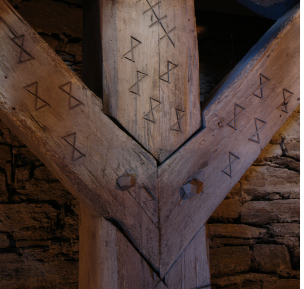
Discussion of ongoing building/historical research, stronghold in Královice (Praha–východ).
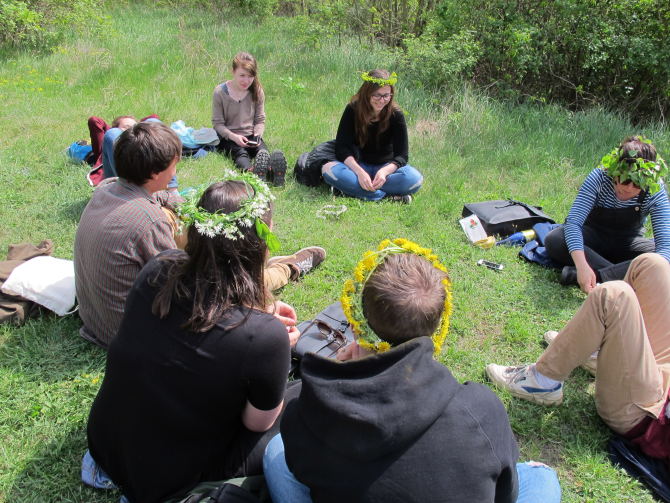
Relaxing on a joint field trip of the “landscapers” and “conservationists” in the Polabí flatlands.
Studio’s retreat seminar in Český Krumlov.
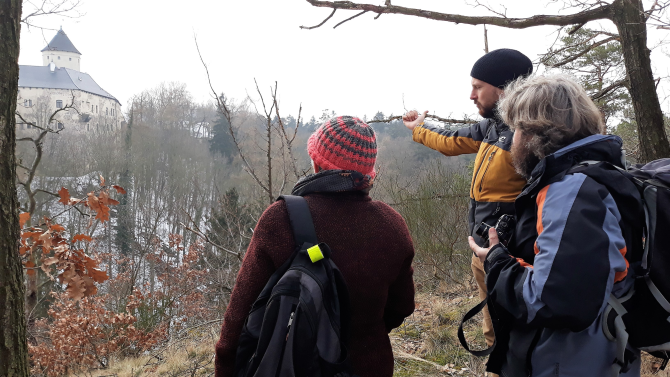
On a tour of a studied area – Rychmburk Castle.
A studio project is preceded by a thorough familiarity with the structure – studio of vernacular architecture in Sobotka Region.

For the content of this site is responsible: doc. Ing. arch. Tomáš Efler